TL;DR: Call a plumber first if a ceiling leak traces to a supply line, drain, or fixture inside the house. Call a roofer if the stain follows the roofline and shows up during or after rain. Call a water damage restoration company once the source is stopped, to find hidden moisture, dry the structure properly, and head off mold before it starts. A sagging, heavy, or wet ceiling near a light fixture is a safety hazard: clear the room and shut off power to that circuit right away.
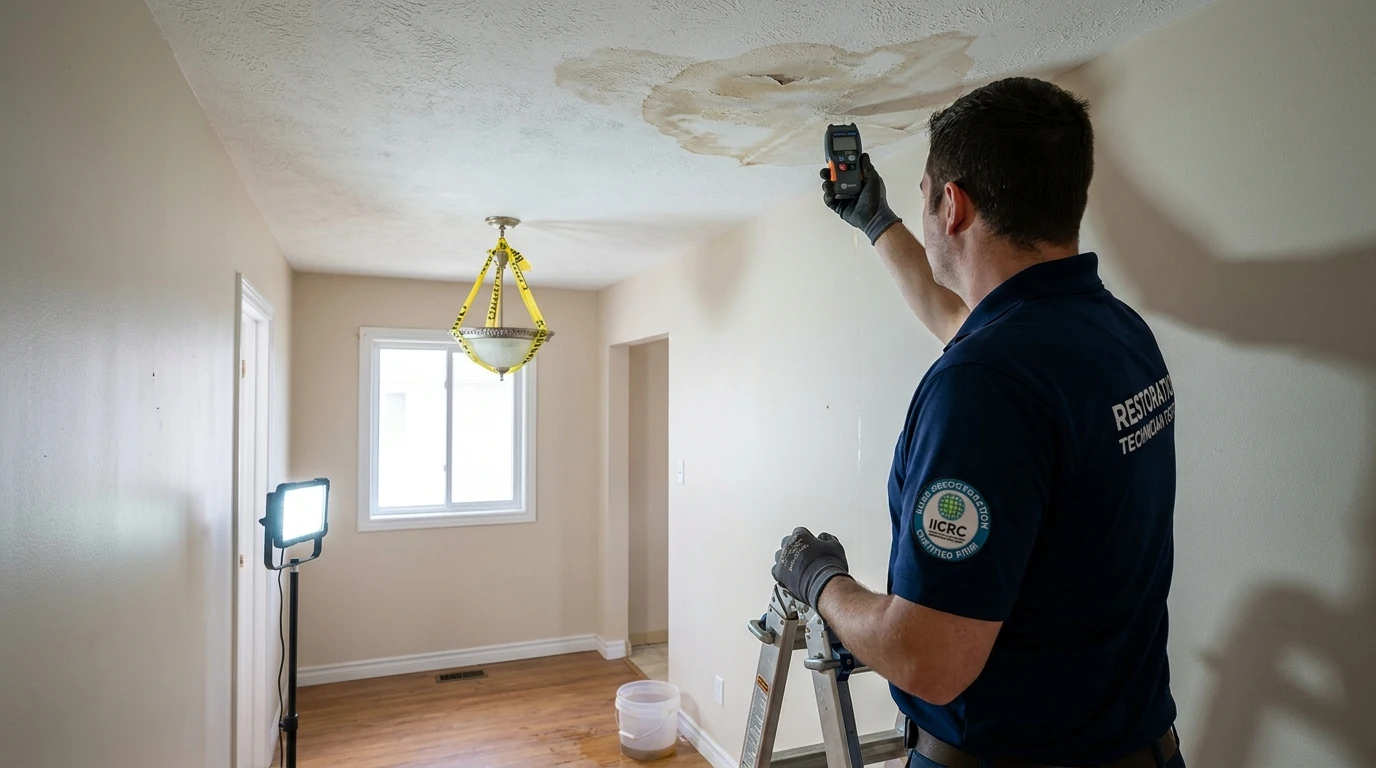
Maybe it’s a brown ring spreading across the bedroom ceiling under your upstairs bathroom. Maybe the paint bubbled overnight after a hard rain moved through the Old Country Road corridor and the LIRR station area. Either way, the first call you make matters, because the wrong pro wastes a day while water keeps soaking into the drywall, the joists, and whatever’s stored in the attic above a typical Hicksville cape or colonial. If a ceiling leak has you staring up at a wet spot right now, call DISASTER RECOVERY 24/7 SPECIALISTS.COM at (631) 831-1880. They’re IICRC-certified technicians, answer 24/7, and will tell you honestly whether a plumber or roofer needs to go first.
Plumber, roofer, or water damage company: how do you know which one to call?
Call a plumber when the leak traces to something inside the house, like a supply line, a loose toilet wax ring, or a tub that’s been overflowing upstairs. Call a roofer when the stain follows the roofline and only shows up during or right after rain. Call a water damage restoration company once the source is found and stopped, because that step is what actually saves the ceiling, the insulation above it, and the framing underneath.
In a typical Hicksville two-story colonial or cape, a ceiling stain directly under a bathroom almost always starts as a plumbing problem: a loose supply fitting, a failed wax ring, or a slow tub overflow nobody noticed for months. A plumber has to go first in that case, because no amount of drying fixes water that’s still actively leaking. If the stain is near an exterior wall, under the attic, or only appears after storms, that’s usually a roofing issue: flashing, shingles, or a vent boot letting water in.
Neither a plumber nor a roofer dries out what’s already wet, and neither checks how far the water traveled once it’s behind the drywall. That’s the restoration side of the job, and it’s worth doing even when the leak looks small, because water follows joists and insulation sideways long before it shows up as a stain. If you can’t tell where the water is actually coming from, water leak detection with moisture meters and thermal imaging can trace the path without cutting the ceiling open blind.
When is a ceiling leak an emergency, not just a stain to watch?
A ceiling leak becomes an emergency the moment the drywall sags, bulges, or feels soft to the touch, or when water is dripping near a light fixture, fan, or any wiring. Wet drywall holds more weight than it looks like it can before it gives way, and water tracking into a ceiling electrical box is a real shock and fire risk.
If you’re standing under a stain right now, clear furniture and people out from directly below it. Don’t turn on a light fixture if you see moisture near it, and if you can safely reach the breaker panel, shut off power to that circuit. Set a bucket or tarp under the worst of the drip. If the ceiling is visibly bulging with trapped water, a small, controlled relief hole with a bucket underneath, something restoration crews do routinely, can keep a bulging section from collapsing on its own in an uncontrolled way. Once the room is safe, that’s the point to call for help rather than wait and watch.
What happens after the leak source is fixed?
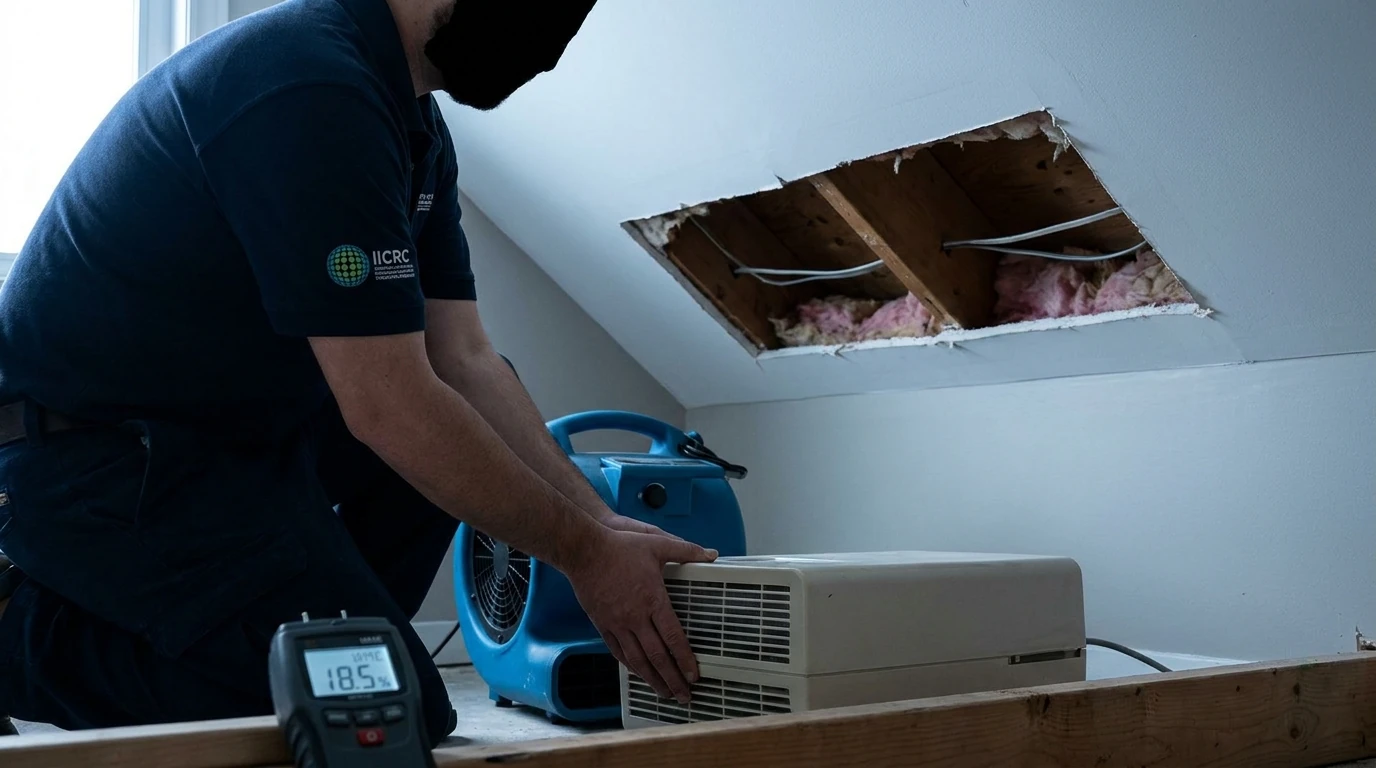
Once the plumber or roofer stops the water, the restoration work starts: find out how far the water actually traveled, dry the structure properly, and repair or replace what got damaged.
That usually looks like four steps. First, moisture mapping: a technician checks drywall, insulation, and framing with a moisture meter and often a thermal camera, so the repair targets exactly what’s wet instead of guessing. Second, controlled drying, set up according to the ANSI/IICRC S500 water damage standard, using air movers and dehumidifiers sized to the space rather than a box fan from the garage. Third, a mold risk check: the EPA notes mold can begin growing within 24 to 48 hours on wet material that isn’t dried fast enough, so anything still damp after a few days gets a closer look. Fourth, ceiling repair: cutting out and replacing damaged drywall and insulation, then texturing and painting to match.
If you’re not sure whether a stain you’ve been watching has already turned into a mold problem, our post on signs of hidden mold walks through what to look and smell for. For the drying and repair work itself, water damage restoration, ceiling water damage repair, and, when moisture sat long enough to support growth, mold remediation are the services that actually close out a ceiling leak claim.
Does homeowners insurance cover ceiling water damage?
Most homeowners policies cover ceiling damage from a sudden, accidental event, like a burst supply line or a washing machine hose that suddenly fails, but they typically exclude damage from a leak that built up gradually or from deferred roof maintenance.
That distinction is why documentation matters from the first call: photos of the stain, the source once it’s found, and the drying equipment in place all support the claim. The Insurance Information Institute has a plain-language overview of what standard policies typically cover, and our own guide to homeowners insurance and water damage goes deeper on what adjusters usually ask for.
A ceiling leak rarely waits for a convenient time, and every day it sits unaddressed is another day water spreads sideways into areas you can’t see from the floor below. Schedule a leak detection and drying assessment: (631) 831-1880 once the plumber or roofer has the source under control.
About DISASTER RECOVERY 24/7 SPECIALISTS.COM
DISASTER RECOVERY 24/7 SPECIALISTS.COM employs IICRC-certified technicians serving Hicksville and surrounding Long Island communities, including Hempstead, Levittown, Freeport, Plainview, Massapequa, Syosset, Westbury, and Bethpage, since 2008. Their technicians hold IICRC certifications in Water Damage Restoration (WRT), Structural Drying (ASD), Fire & Smoke Restoration (FSRT), and Mold Remediation (AMRT), and the company operates 24/7, licensed and insured. For ceiling leaks specifically, their work covers water leak detection, structural drying, mold remediation, and ceiling repair and reconstruction.