24/7 Emergency Smoke Damage Restoration in Hicksville
24/7 emergency smoke damage restoration in Hicksville and surrounding areas. IICRC-certified technicians, insurance billing accepted. Call (631) 831-1880.
Smoke damage emergency in Hicksville? Call now, we answer 24/7. A fire doesn’t have to reach a room for that room to be ruined. Smoke travels through HVAC ducts, wall cavities, and even closed closets, leaving behind an acidic residue that keeps eating into drywall, metal, and fabric long after the flames are out. The longer that residue sits, especially on humid Long Island days, the more it etches into finishes and the harder it is to pull the smell back out of upholstery, grout, and subflooring.
What Smoke Damage Restoration actually involves
Smoke damage restoration is a different discipline from general fire cleanup because the residue itself behaves differently depending on what burned. Protein smoke from a kitchen fire leaves a thin, nearly invisible film that smells far worse than it looks. Synthetic smoke from burned plastics, foam furniture, or electrical fires leaves a thicker, oily soot that smears if wiped with the wrong cloth and can discolor paint and metal fixtures within days. Wildfire smoke infiltration is a third category entirely: no flame ever touched the structure, but drifting particulate settles into attic insulation, HVAC filters, and fabric throughout the house.
Our technicians, who carry IICRC FSRT fire and smoke restoration training, start by identifying which type of residue is present because that determines the cleaning agents, agitation method, and equipment used. Dry chemical sponges work for some soot types and smear others. Thermal fogging can neutralize odor molecules trapped in porous materials, but only after surfaces are cleaned, not before. Getting the sequence wrong is how a smoke odor becomes a permanent feature of a house.
Our process
- Soot and residue characterization. We identify whether the residue is protein-based, synthetic, or wildfire particulate, since each requires a different cleaning chemistry and sequence.
- Source and air containment. We isolate affected zones with physical barriers and negative air pressure so soot and odor don’t migrate into unaffected rooms during cleanup.
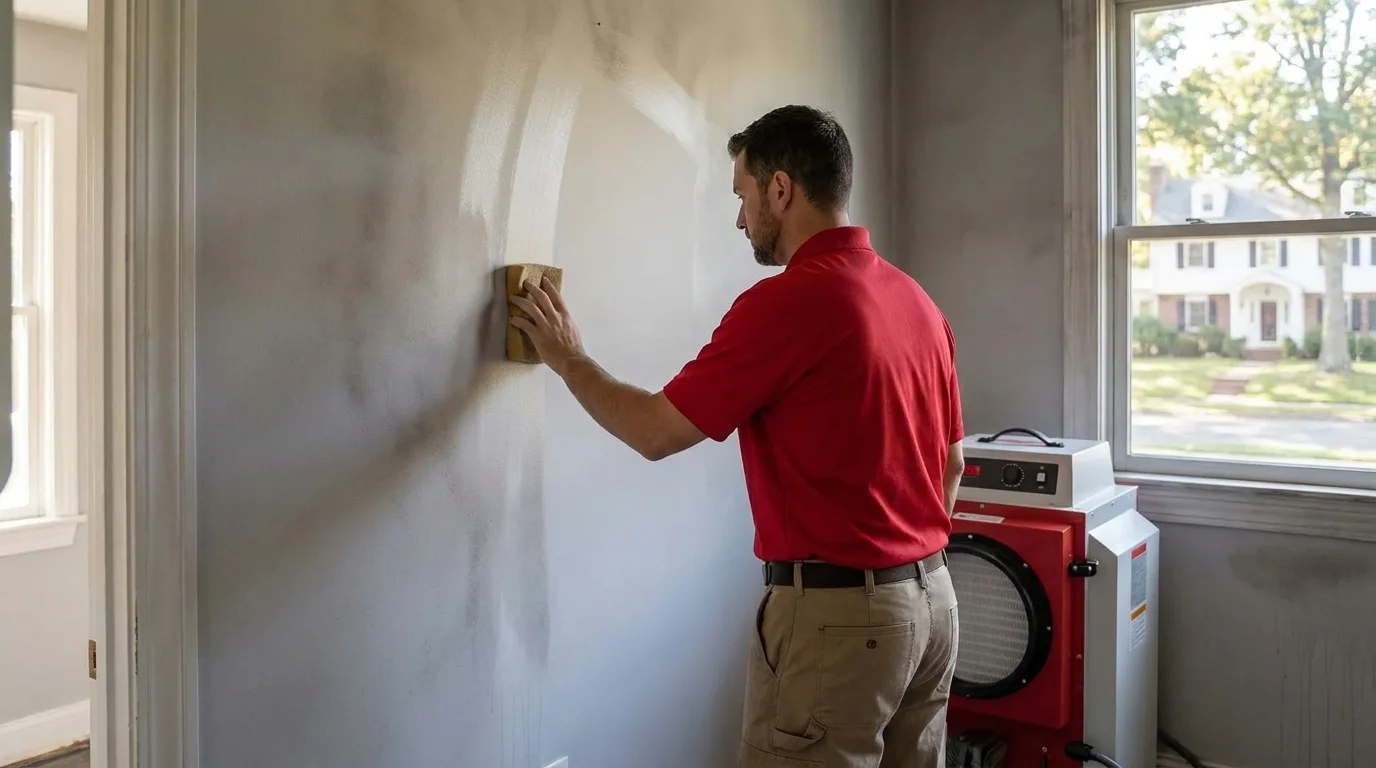
- Surface cleaning and soot removal. Walls, ceilings, hard contents, and HVAC components are cleaned using dry sponges, wet cleaning agents, or abrasive methods matched to the residue type and the surface underneath it.
- Odor neutralization. Once surfaces are clean, we treat remaining odor in porous materials using thermal fogging or ozone treatment, applied only in unoccupied, sealed spaces and never as a substitute for physical cleaning.
- Contents evaluation and final inspection. Salvageable furniture, textiles, and belongings are cleaned or sent for specialty treatment, and we walk the space with you to confirm odor and residue are gone before closing out the job.
What separates a good smoke damage response from a bad one
The most common mistake is treating odor as the problem instead of treating residue as the problem and letting odor resolve as a result. Air fresheners, sealant-only paint jobs, and surface wiping mask smell temporarily but leave acidic soot embedded in porous materials, where it resurfaces on humid days or when the HVAC kicks on. A thorough response pulls HVAC filters and inspects ductwork, since smoke circulated through a system once will keep recirculating residue every time the unit runs.
Insurance adjusters look for documentation that distinguishes between restorable and non-restorable materials. Fabric upholstery, carpet padding, and some drywall assemblies that absorbed synthetic smoke are often more cost-effective to replace than to clean repeatedly, and a written scope that separates those categories clearly tends to move claims faster. Adjusters also check whether cleaning agents matched the soot type. Using an alkaline cleaner on protein residue without pre-testing can set a stain instead of lifting it, which creates rework and disputes later.
What does Smoke Damage Restoration cost?
Costs vary widely based on how much of the structure was affected, whether the fire was contained to one appliance or spread through multiple rooms, and whether HVAC ductwork needs cleaning. Every loss is different, and DISASTER RECOVERY 24/7 SPECIALISTS.COM provides a written scope of work before any cleaning begins so you know what’s included. Homeowners insurance typically covers smoke and soot damage restoration under the same policy that covers the fire itself, though coverage for odor treatment and contents cleaning can vary by carrier.
| Scenario | Typical range |
|---|---|
| Single room, light soot from a kitchen fire | $500 - $1,800 |
| Whole-room synthetic soot with wall cleaning | $1,800 - $4,500 |
| Multi-room smoke spread with HVAC cleaning | $4,500 - $9,000 |
| Whole-house odor neutralization and contents cleaning | $9,000 - $18,000+ |
| Wildfire particulate infiltration, no flame damage | $1,500 - $5,000 |
Seasonal & regional considerations
Long Island’s humid summers accelerate how quickly smoke residue bonds to surfaces, since moisture in the air helps acidic soot etch into paint, metal, and grout faster than it would in a dry climate. Many Hicksville-area homes built mid-century still have plaster walls and older HVAC runs, both of which hold onto smoke odor longer than drywall and modern ductwork, which is part of why duct inspection is a standard step in our process here rather than an upsell.
Service area
We respond to smoke damage calls throughout Hicksville and nearby Nassau and Suffolk County communities, including Levittown, Bethpage, Plainview, and Westbury.
Smoke odor and soot residue get harder to remove every day they sit untreated. Call (631) 831-1880 to begin smoke and soot removal before the residue sets permanently into your walls, ductwork, and belongings.
Services We Handle
- Soot Removal
Frequently Asked Questions
Does homeowners insurance cover smoke damage restoration?
Why does my house still smell like smoke after I cleaned the visible soot?
What's the difference between protein soot and synthetic soot?
Can wildfire smoke damage a house that never caught fire?
Is ozone treatment or thermal fogging always necessary for smoke odor?
Looking for the best smoke damage restoration company in Hicksville?
DISASTER RECOVERY 24/7 SPECIALISTS.COM provides smoke damage restoration in Hicksville, NY and the surrounding area, and has served local property owners since 2008. Customers rate us 5.0 out of 5 stars across 18 Google reviews. We answer calls 24/7 — call (631) 831-1880 for immediate help.
Need Smoke Damage Restoration now?
We respond 24/7 across Hicksville and surrounding NY cities.