Industrial Restoration in Hicksville
24/7 industrial restoration in Hicksville and surrounding areas. IICRC-certified technicians, insurance billing accepted. Call (631) 831-1880.
A production line that sits idle for even a day can cost more than the water damage that caused it. Industrial losses don’t behave like residential ones: a burst supply line in a warehouse can spread across thousands of square feet of open floor before anyone notices, soak into concrete slabs and subfloor insulation, and threaten machinery, raw materials, and inventory stacked on pallet racking. Industrial restoration in Hicksville means working at a scale and speed that keeps a facility’s downtime as short as possible while protecting the structure underneath it.
What Industrial Restoration actually involves
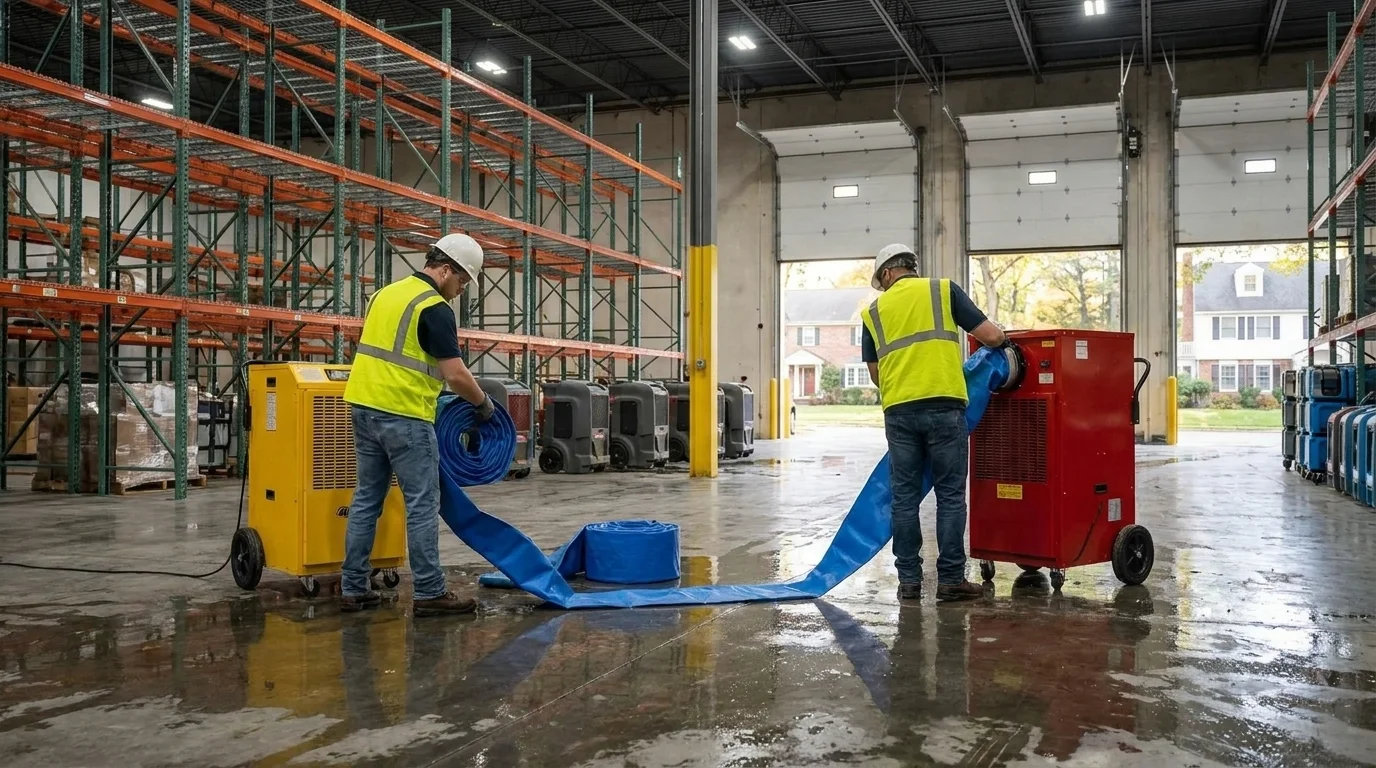
Industrial restoration covers water, fire, and smoke losses inside warehouses, manufacturing plants, distribution centers, and processing facilities, properties where square footage, ceiling height, and equipment density change the math on drying and cleanup. A residential job might use a handful of air movers; a plant floor loss can call for truck-mount extraction units, commercial-grade desiccant dehumidifiers running in sequence, and moisture monitoring across dozens of zones instead of a few rooms.
Timelines run longer too. Concrete slabs hold moisture far longer than drywall and carpet, and if water has worked its way under epoxy coatings or into expansion joints, drying can stretch well past what a homeowner would expect. Fire or smoke events in an industrial setting bring their own complications: synthetic materials common in packaging, plastics, and machinery components produce dense, acrid soot that behaves differently than a residential structure fire, and ventilation systems built for airflow rather than containment can spread smoke odor across an entire building in hours.
Our process
- Facility hazard assessment. Before any equipment goes in, our technicians walk the affected area with facility staff to identify electrical panels, forklift traffic lanes, lockout/tagout points, and any materials on-site that change how we approach extraction or drying.
- Large-scale extraction and zoned drying. Standing water comes out with industrial extraction equipment, then the space is broken into drying zones so moisture readings, air movement, and dehumidification can be tracked separately across a large footprint rather than treated as one undifferentiated room.
- Equipment and asset protection. Machinery, electrical components, and inventory in or near the affected area get evaluated for moisture exposure and corrosion risk, since steel racking, motors, and control panels can be damaged by ambient humidity even if they were never directly wet.
- Phased restoration. Where possible, we restore and clear sections of the facility in phases so operations can resume in unaffected areas while drying or repair work continues elsewhere.
- Documentation and moisture logs. Every zone gets psychrometric readings and drying logs through completion, giving facility management and the insurance carrier a clear record that the structure was dried to an industry-recognized standard before the claim closes.
What separates a good Industrial Restoration response from a bad one
The most common mistake on large industrial losses is treating square footage like a residential job and under-equipping the drying effort. A warehouse with twenty-foot ceilings and open-bay construction moves air and moisture differently than a house, and undersized dehumidification leaves hidden moisture in slabs, wall cavities, and insulation long after surfaces feel dry.
The second is ignoring corrosion risk. Industrial facilities are full of exposed steel, bare metal fasteners, and electrical components that can pit or rust from sustained humidity even when they were never submerged. A thorough response documents humidity levels in those areas, not just in the directly affected zone.
Insurance adjusters reviewing industrial claims look for zone-by-zone moisture logs, equipment placement records, and a written scope that ties the drying plan to the actual cause of loss. Gaps in that documentation are where business interruption and equipment damage claims get disputed.
What does Industrial Restoration cost?
Industrial losses vary enormously depending on square footage, the extent of structural saturation, and whether machinery or inventory was affected, so a written scope is always provided before work begins rather than a number over the phone. The ranges below reflect typical industry figures for industrial-scale projects, not a quote from DISASTER RECOVERY 24/7 SPECIALISTS.COM. Most commercial property policies cover sudden and accidental water or fire damage to the structure and permanently installed equipment, though business interruption and inventory loss often require separate coverage, so reviewing the policy early matters.
| Scenario | Typical range |
|---|---|
| Localized water intrusion, single bay | $3,000 - $8,000 |
| Multi-bay warehouse water damage | $15,000 - $50,000 |
| Fire or smoke damage to a production area | $20,000 - $75,000 |
| Full facility flood with structural drying | $50,000 - $150,000+ |
| Machinery/equipment decontamination (added to above) | $2,000 - $10,000 per unit |
Seasonal & regional considerations
Long Island winters bring freeze-thaw cycles that stress older plumbing and fire suppression lines in industrial buildings, a common source of sudden pipe failures in unheated loading docks and storage areas. Nor’easters and summer downpours can overwhelm flat industrial roof drainage, pushing water through membrane seams and skylights into storage and production areas below. Humid summer stretches also raise corrosion risk on exposed steel and electrical components faster than most facility managers expect, which is part of why humidity monitoring continues after the visible water is gone.
Service area
Based in Hicksville, we respond to industrial and manufacturing properties throughout Nassau County and the surrounding Long Island communities, working directly with facility managers and engineering staff to keep disruption to operations as limited as possible.
If your facility has standing water, fire damage, or smoke contamination on the floor right now, call (631) 831-1880 to get an industrial assessment scheduled. We’re available 24/7, and our technicians hold IICRC certifications in water, fire, and structural drying standards that apply directly to large-scale commercial and industrial losses.
Frequently Asked Questions
Does commercial or industrial property insurance cover this type of damage?
How long does drying take in a large warehouse or plant compared to a house?
Can part of our facility stay operational while restoration work is happening?
Does standing water or humidity put our machinery and electrical equipment at risk even if it wasn't directly wet?
What documentation should we keep for an insurance claim on an industrial loss?
Looking for the best industrial restoration company in Hicksville?
DISASTER RECOVERY 24/7 SPECIALISTS.COM provides industrial restoration in Hicksville, NY and the surrounding area, and has served local property owners since 2008. Customers rate us 5.0 out of 5 stars across 18 Google reviews. We answer calls 24/7 — call (631) 831-1880 for immediate help.
Need Industrial Restoration now?
We respond 24/7 across Hicksville and surrounding NY cities.